Duplicate orders? Not anymore. WooCommerce protection is now included!
Upgrade to PRO for Checkout Blocks, analytics and smart order linking.

Choose the Unique Fields in WordPress Forms (How It Works)

Choose the Unique Fields in WordPress Forms (Duplicate Check)

One of the most important steps in preventing duplicate submissions is choosing the right fields to validate.

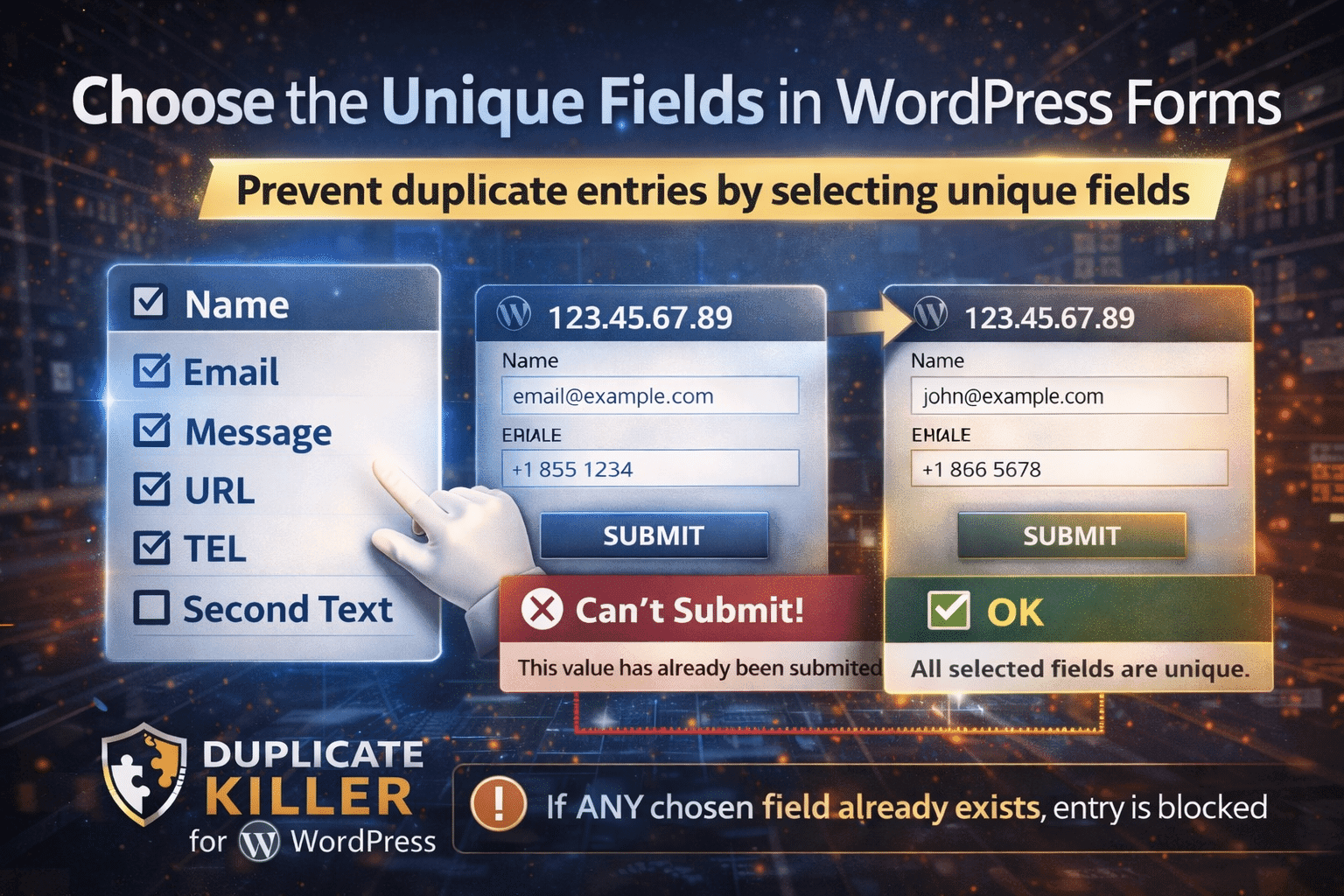
The Choose the unique fields in WordPress forms feature allows you to select exactly which form fields should be checked for duplicates before a submission is saved.

Instead of blocking entire forms, you control which specific values must remain unique.


What Does “Choose the Unique Fields” Mean?

When you use Choose the unique fields in WordPress forms, you decide which input fields should not allow duplicate values.

This means:

  • If a selected field value already exists, the submission is blocked.
  • If the value is new, the submission is allowed.
  • You can select one or multiple fields.

This gives you full flexibility and precision.


Available Field Types You Can Make Unique

You can apply duplicate validation to different types of fields, including:

  • Name (text)
  • Email (email)
  • Message (textarea)
  • URL (url)
  • TEL (tel)
  • Second Text (text)

The user selects the field or fields that should not accept duplicate entries.

Example: Name + Email Selected

If you select both Name and Email, the rule becomes:

  • Name must not exist already
    AND
  • Email must not exist already

So:

  • Same email, different name → blocked (because Email already exists)
  • Same name, different email → blocked (because Name already exists)
  • Both new → allowed

How Duplicate Validation Works

Once you choose the unique fields in WordPress forms, the system checks the database before saving a new submission.

If a duplicate is detected:

  • The submission is stopped.
  • A validation error message appears.
  • The entry is not stored.

If no duplicate is found:

  • The submission proceeds normally.

This happens instantly during form validation.


Choosing One Field vs Multiple Fields

You can select:

Single Field Validation

Example:

  • Email must be unique.

If the email already exists, the submission is blocked.


Multiple Field Combination Validation

Example:

  • Name + Email must match exactly to be considered duplicate.

This means:

  • Same email but different name → allowed.
  • Same name and same email → blocked.

This gives you more advanced duplicate control.


Best Practices: What Should You Choose?

Here are recommended strategies:

✔ Use Email for contact forms
✔ Use Email or Username for registration forms
✔ Use TEL for lead generation forms
✔ Use combinations for advanced filtering
✔ Avoid making large textarea fields unique unless necessary

Choosing the correct unique fields ensures:

  • Clean data
  • Accurate reporting
  • Better CRM integration
  • Fewer duplicate leads

When Should You Avoid Making a Field Unique?

Do not make a field unique if:

  • The field naturally repeats (e.g., common names)
  • You expect multiple legitimate submissions
  • The field does not identify the user

The goal is smart validation, not over-restriction.


Why Choosing the Right Unique Fields Matters

If you select the wrong fields:

  • You may block legitimate submissions.
  • You may allow unwanted duplicates.
  • You may distort reporting.

That’s why the Choose the unique fields in WordPress forms feature gives you precise control.

You decide what matters.

Related Articles

Cross-Form Duplicate Protection in WordPress Forms

Cross-Form Duplicate Protection in WordPress Forms

A Complete Guide with Real-World Examples Duplicate form submissions are a common problem on WordPress websites. Most site owners focus on preventing duplicates inside a single form, but the real challenge often appears when multiple forms collect the same data across different pages. For example: If the same visitor submits their email in multiple places,…
WordPress Form POST Replay Protection: Why It Matters

WordPress Form POST Replay Protection: Why It Matters

When developers talk about duplicate form submissions in WordPress, the conversation usually focuses on users clicking the submit button twice. However, there is a less obvious technical issue that can cause the same form request to be processed multiple times: POST replay. POST replay occurs when the same HTTP request is delivered to the server…
WooCommerce Checkout Blocks vs Classic Checkout: Why Duplicate Killer FREE Works Only With Shortcodes

WooCommerce Checkout Blocks vs Classic Checkout: Why Duplicate Killer FREE Works Only With Shortcodes

If you enabled Duplicate Killer’s WooCommerce protection and it “does nothing”, you’re probably using WooCommerce Checkout Blocks. This is not a bug. It’s a technical difference between Classic Checkout (shortcode-based) and Checkout Blocks (block-based / Store API-based). Below is a simple explanation, plus examples and what you can do. Quick Summary Duplicate Killer FREE (WooCommerce)…
Limit Submissions by IP Address in WordPress (Free & PRO)

Limit Submissions by IP Address in WordPress (Free & PRO)

Repeated form submissions don’t always come from cookies or browser refreshes. Sometimes, users try to submit the same form multiple times from the same network. That’s where Limit submissions by IP address in WordPress becomes essential. This feature restricts form entries based on the visitor’s IP address for a defined number of days. What Does…
Unique Entries per User in WordPress: How to Use It

Unique Entries per User in WordPress: How to Use It

Duplicate form submissions are not always caused by multiple users.Sometimes, the same user submits the same form multiple times — intentionally or by mistake. The Unique entries per user in WordPress feature solves exactly this problem. Instead of blocking duplicate values globally, this option ensures that a single user cannot submit the same entry more…
What is the “Set Error Message” field in Duplicate Killer

What is the “Set Error Message” field in Duplicate Killer

The Set error message field allows you to define the message displayed to users when they try to submit a value that has already been submitted before. In simple terms, this message appears when Duplicate Killer detects a duplicate entry based on the unique field(s) you have configured (for example, email address, phone number, order…
WordPress Form Resubmits on Refresh: How to Prevent It

WordPress Form Resubmits on Refresh: How to Prevent It

A common WordPress forms issue is resubmission on refresh. A user submits a form, then refreshes the page (or returns using the back button) and the browser tries to submit the same POST request again. If your site accepts it, you get duplicate entries, duplicate emails, and duplicate leads. Why forms resubmit on refresh This…
Contact Form 7 Sending Emails Twice? Here’s the Real Fix

Contact Form 7 Sending Emails Twice? Here’s the Real Fix

If your Contact Form 7 emails are being sent twice, you’re not alone. This issue is common on WordPress sites with caching, optimization plugins, unstable networks, or multiple integrations firing on submit. The key is to stop guessing and identify the real trigger that creates the duplicate send. What “sending twice” usually means There are…
Go to VerseLabWP homepage
© Copyright 2025 BITSTRUCT SRL. All Rights Reserved.